The 600kg Microlight category has the potential to play a significant part in the future of UK General Aviation. Ian Seager jumps from his (relatively) heavy C182 into the Skyleader 400
17 August 2025
We’ve been following the Skyleader 400 (and its bigger sibling the retractable gear 600) since 2022. It would be fair to say that full BMAA approval for the aircraft as a 600kg ‘Light Sport Microlight’ took a little longer than expected, but it’s well and truly here now.
After following the story for so long, we finally got our hands on the aircraft when Ashok Aliseril, the UK agent brought it into Lydeway Airstrip recently. Before we get to the fun bit, it’s worth a brief recap of the aircraft.
Watch our accompanying video on flying the Skyleader 400 here
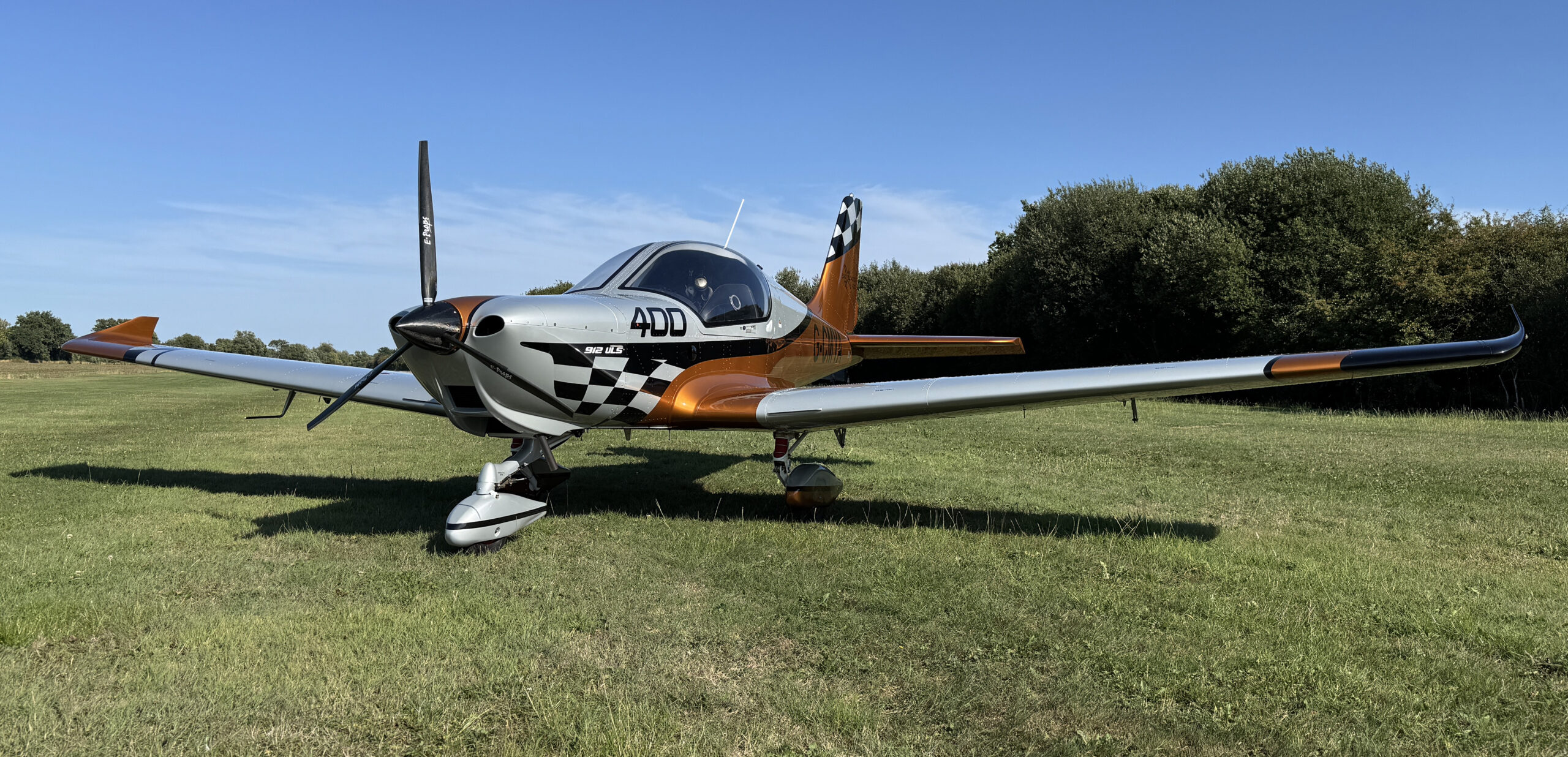
The Skyleader 400 is a Czech-built, low wing all-metal side by side microlight powered by the 100hp Rotax 912 ULS. It has a fixed undercarriage with training link main gear, a steerable nose gear and it’s equipped with a Ballistic Recovery System with the rocket and parachute located under the cowling ahead of the right seat.
Wingspan, complete with mini winglets, comes in at 9.16m (30ft), length at 6.4m (21ft) and height at 2.37m (7ft 9in). Each wing has a 60 litre fuel tank, so if you have enough useful load you can fill the tanks and fly for longer than you’d probably want before needing to find fuel.
It’s available in Club or Sport configuration with the Sport version having full height seats and a centre console (which incorporates the throttle) while the Club version has bench seats, no console and the throttle is built into the panel. Both versions have a baggage bay that’ll cope with a couple of (non US traveller sized) carry-on bags as long as they don’t exceed 30kg (66lb).
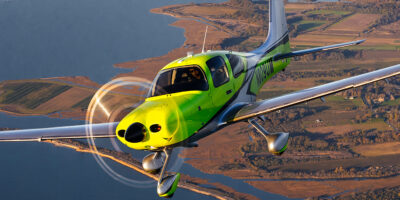
So what’s it actually like? I’ve never been completely sure about the Skyleader’s looks, but having had the opportunity to get up close, and to see it in its natural habitat (ie on an airfield rather than in an exhibition hall) I’m quite taken by its appearance.
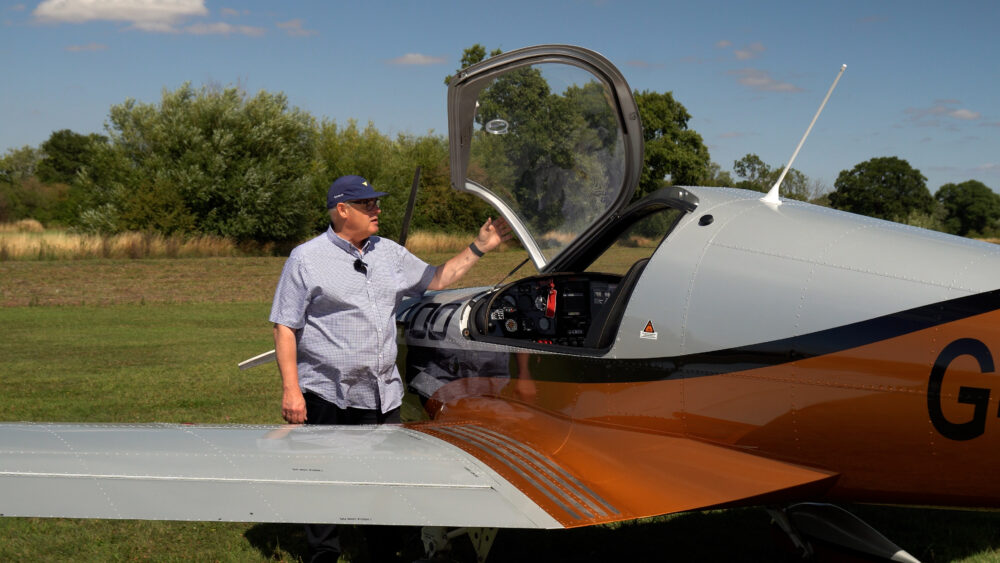
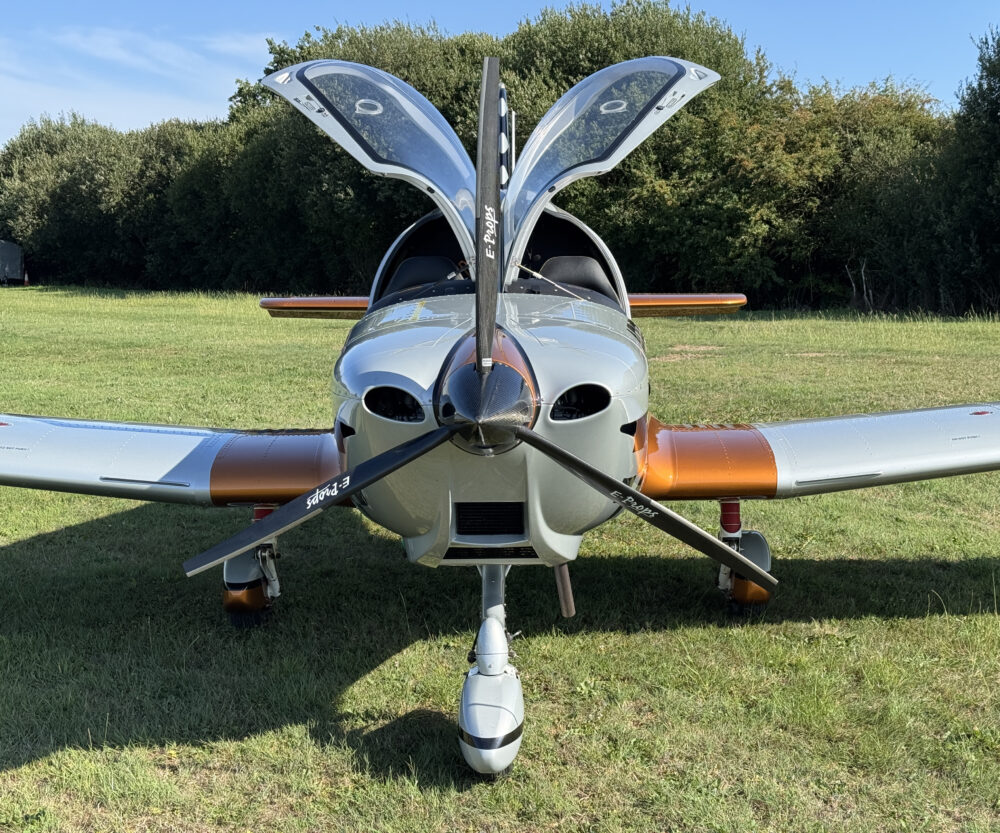
I like the mini winglets. I like the overall silhouette and I think they’ve done a decent job of the nosewheel. You could sum up by saying that it is conventional, done well but that would be forgetting something. The screen is split by a fairly chunky vertical bar onto which are attached two gullwing doors. I’ve never been sure of these either, but from an aesthetic and operational point of view I’m converted. More about the view out when we go flying.
Finally, this particular aeroplane had a three bladed carbon fibre propeller from E-Props. I know that it’s light, I know it’s efficient, and I know you can’t see it when the engine is running, but personally I struggle with the look of the toothpick style blade, and that didn’t grow on me. Maybe because I’m a set-in-my-ways Boomer with a history of heavier GA aircraft and chunky props.
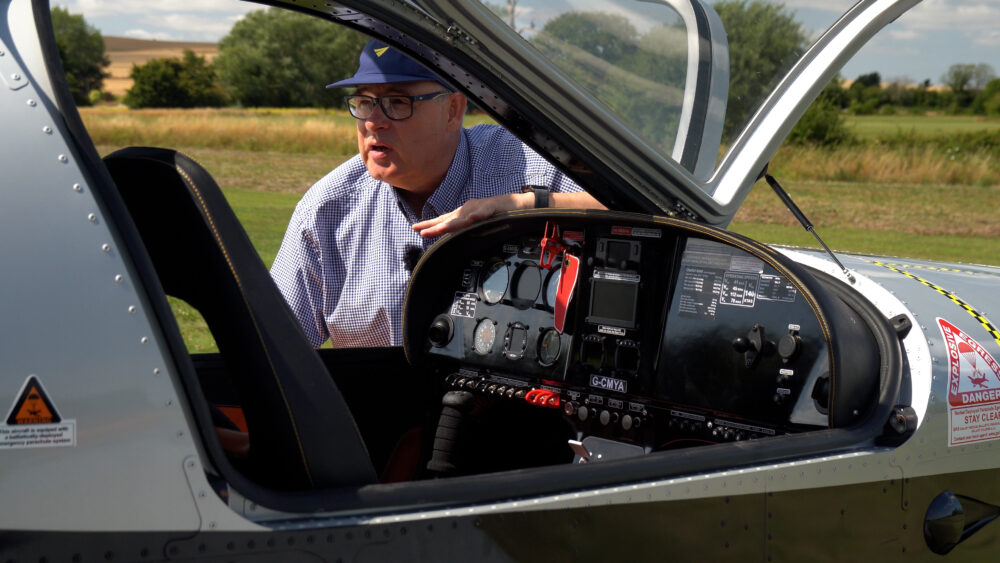
G-CMYA is the Sport version, so the cockpit comes with a couple of individual seats, a centre console which houses throttle, choke, parking brake, fuel selector (the first non-Andair selector I’ve seen in a new aeroplane for years) and a flap lever. This sits right next to what seems to me to be a pointless flap indicator. Unlike the Club version, the seats are fixed in position and there are a couple of pull-to-adjust knobs that make repositioning the rudder pedals easy.
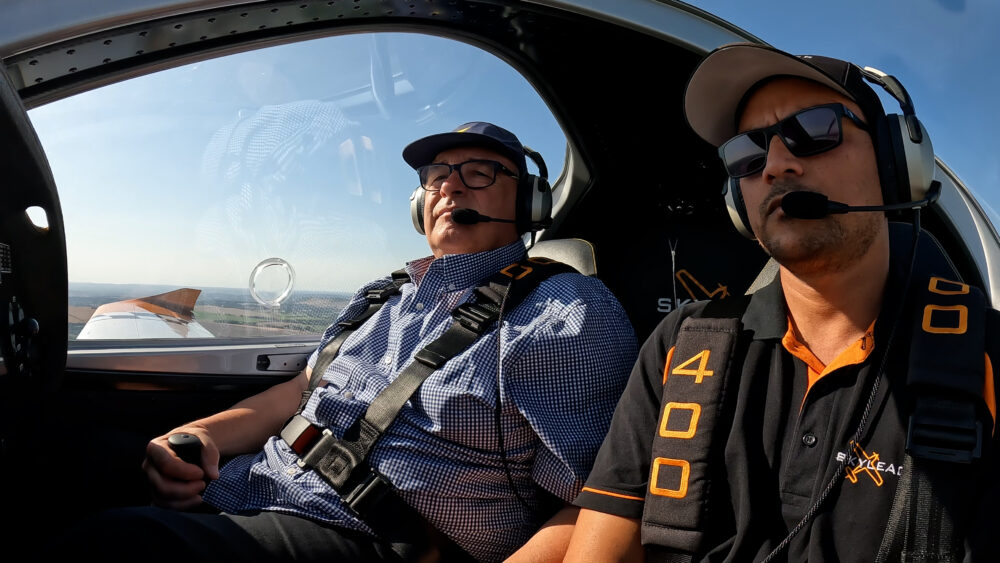
Ashok wasn’t keen on flying right seat so I flew in the P2 position. Not an issue, but the lack of trim (the electric trim being only on the P1 stick) is something that would make life and judgement a bit harder than ideal.
You get in the aircraft by stepping up onto the wing. It’s not an impossibly big step, but some people (me in a few years?) are going to find it a bit of a challenge. Adding structure to build in a strong enough external step would add weight and cost, but someone should add it to the designer’s ToDo list. From the wing you step onto the cockpit floor in front of the seats, while ducking to avoid smacking your head on the gull-wing door. You then use the handy hand hold to lower yourself into your comfortable high back seat.
The collection of instruments in YA have an analogue style but are mainly electronic. The right hand panel is home to a collection of eight placards, with another TEN elsewhere, and that’s not counting the switch or CB labels.
Right, time to taxi. Forward visibility is good, and the chunky main pillar doesn’t seem to get in the way, something that was to carry forward into the flying. Looking out to the side obviously the low wing gets in the way if you need to look down, and visibility to the rear quarters is restricted by the high back seats and fuselage structure. Those gull-wing doors are great (and operate brilliantly), but it’s no bubble canopy.
I mentioned earlier that the nosewheel was steerable which generally makes for a bigger turning circle. I’m not an aircraft designer, but would have thought that a fully castoring nosewheel would be simpler, cheaper and lighter while giving better manoeuvrability on the ground.
I’d asked Ashok to fly the first take-off, and when my turn came, with the trim set by Ashok, I went slowly to full power and we trundled down the runway. The website says you need a ground run of 130 metres to get airborne and another 245m to clear that hypothetical 15m obstacle. While the aeroplane is certainly not a runway hog, it’s not super STOL either (although compared to most heavier GA types it’s definitely short field). My take-off had the stall warner chirping, of which more later.
The afternoon was a bit breezy and thermic, and we did get bounced around. I’d be willing to bet that it was more stable than some other super light microlights in the same conditions, but I imagine you get pretty good at seeking out smoother air, on which subject it’s worth mentioning that with the fitted cruise prop, full power gave a more than decent 1,000ft/min in the climb.
It’s hard for me to judge the handling given the addition of turbulence and lack of easy access to the trim, but it’s certainly on the less twitchy part of the spectrum, and I mean that in a positive way.
An important aside, YA is equipped with a Kanardia autopilot that has a button marked LVL. Autopilots from Garmin have that too. Avidyne has a button marked STRAIGHT AND LEVEL and Dynon has one marked LEVEL. All of them are there to be used when you get disoriented and need the avionics to step in and dig you out of trouble. I rolled to maybe 40 degrees left wing low in a shallow descent and pressed the Kanardia’s LVL button, only to be told that we were outside of the parameters for engagement. It’s basically a button to hold straight and level if you are pretty close to straight and level when you engage the autopilot. I’m not a fan.
I did fly an approach to Wadswick Airstrip during the flight, and the first thing that struck me was the time it took to slow from a 100kt cruise to the 70kt needed for the first stage of flap (the next stage at 65kt is obviously less of a challenge). To be fair that may have more to do with not taking off enough power, or not trimming. The stall warner happily chirped away somewhere between 65kt and 70kt which came as a bit of a surprise given the Vso is placarded at 41kt. We didn’t stall, and the approach was somewhere near stable given the turbulence.
Back at Lydeway I got Ashok to demo a landing, and then flew one of my own. There’s not a huge amount to say other than I was happy with the approach and hold off, and the Skyleader’s trailing link undercarriage does its job well (no, it wasn’t particularly challenged).
So where does that leave us? The Skyleader looks good, it feels well built and it performs like almost all other side by side two-seat metal Rotax aircraft. Looks are very personal, but I’d certainly be happy opening the hangar door to find a Skyleader waiting for me.
Depending on configuration, avionics fit and paint, a buyer should budget between £120,000 and £180,000 (including VAT), but for that you’ll get a modern and comfortable tourer that sits under the BMAA regulatory umbrella while sipping avgas (leaded or unleaded) or even mogas at about 18 litres per hour.
Microlight pilots may find it a somewhat solid and not exactly bargain-basement, while GA flyers will love the cheap running costs but might raise an eyebrow when the turbulence reminds them this isn’t a certified aircraft with significantly more weight and a higher wing loading.