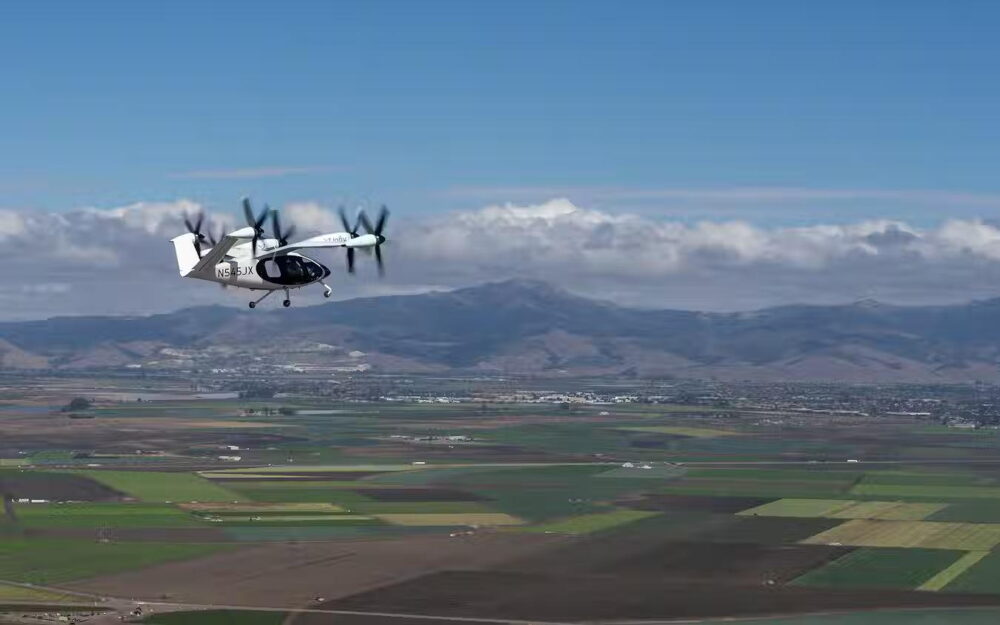
One of the leading companies developing electric Vertical Take-Off and Landing air taxis (eVTOL), Joby Aviation, flew its all-electric aircraft at the recent California International Airshow in Salinas, including round-trip flights between Marina and Salinas airports.
Each flight lifted off vertically from Marina, transitioned to cruise for the short flight to Salinas, and then back to hover with a pilot onboard.
Crowds watched the aircraft perform a series of manoeuvres, from steep climbs to precise hovers, before it returned to Marina and landed vertically.

Joby said the flights demonstrated the reliability of the aircraft and the maturity of its operational capabilities as it approaches FAA type inspection flight testing early next year.
The audience “also experienced the aircraft’s remarkable quietness, a key feature for urban operations where noise is a major concern,” said Joby.
JoeBen Bevirt, founder and CEO of Joby Aviation, added, “We’ve had the privilege of flying in places like Japan and Dubai this year, but seeing our aircraft fly at home on the Central Coast and sharing it with our neighbours was truly special.”
Joby has flown more than 40,000 miles in urban air mobility demonstrations, showcasing vertical take-offs and landings that mirror future air taxi operations.
After flying at destinations around the world, including in Japan, Dubai, South Korea, New York City, and now, Salinas, Joby will next perform at the Dubai Airshow, 17-21 November 2025.
Patrick D, Joby’s Director of Engineering, said on LinkedIn, “A small step for Joby, a giant leap for the eVTOL industry!
“This 12-minute journey covered 10 nautical miles and even included a 5-minute hold in Monterey’s airspace to coordinate with other aircraft.
“Most importantly, it took place entirely in FAA-controlled airspace, demonstrating seamless integration with conventional air traffic.
“Why does this matter?
“It shows eVTOL aircraft can safely operate in regulated airspace alongside traditional aviation. It boosts market confidence and brings us closer to commercial operations. [And] It’s another sign that the future of advanced air mobility is becoming a reality.”
Joby Aviation