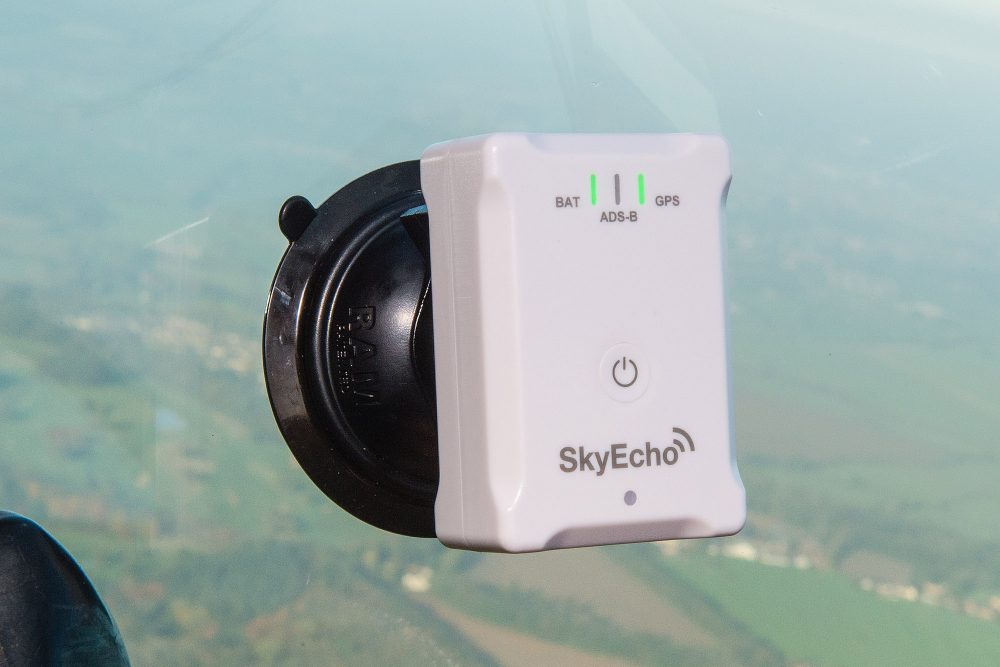
In its strongest signal yet, the UK Civil Aviation Authority (CAA) has implied that ADS-B electronic conspicuity will become mandatory for most aircraft operating in UK lower airspace.
The direction of travel emerges from the regulator’s newly published consultation response, CAP 3217, which outlines how electronic visibility will underpin future airspace integration between manned aircraft and drones.
The document summarises more than 800 responses to the CAA’s consultation on its ‘Initial Technical Concept of Operations’ for Electronic Conspicuity (EC). While the regulator has not yet introduced a formal mandate, the policy framework described makes clear that ADS-B is expected to become the common electronic visibility standard across UK airspace.
Electronic Conspicuity allows aircraft to broadcast their position electronically so that other aircraft, ground systems and unmanned aircraft can detect them. The CAA sees EC as a key tool for improving situational awareness, reducing the risk of mid-air collisions and enabling the safe integration of drones operating beyond visual line of sight (BVLOS).

This is why: drones need to operate outside the ‘see and avoid’ rules. Photo: Everdrone
ADS-B is preferred standard
The UK currently has a mixed EC environment that includes ADS-B, FLARM and PilotAware. However, the consultation response indicates that ADS-B will increasingly become the core technology for electronic visibility.
Under the concept outlined by the CAA, most aircraft operating in non-segregated airspace would eventually be expected to transmit ADS-B Out. The proposal introduces two broad equipment categories: aircraft operating below around 140 knots could use lower-integrity ADS-B devices such as those approved under CAP1391, while faster aircraft would require certified Mode S transponders with ADS-B Extended Squitter capability.
Although these proposals have not yet been formalised as regulations, the CAA’s roadmap indicates that ADS-B equipage requirements are likely to form the basis of a future Electronic Conspicuity mandate.
Strong reaction from GA
Responses to the consultation reveal significant differences of opinion across the aviation community.
While many respondents acknowledge the potential safety benefits of EC, the proposed equipment requirements for slower aircraft attracted strong opposition.
A large proportion of responses came from air sports pilots – particularly those flying paragliders, hang gliders and paramotors – who raised concerns about cost, weight, power requirements and practicality.
Other respondents questioned whether the speed-based threshold proposed in the concept is appropriate and argue that unmanned aircraft operators should bear more responsibility for detecting manned traffic.
Despite the concerns, there was broad support for the principle that drones operating BVLOS should transmit electronic conspicuity signals and be capable of receiving signals from other aircraft.
Look out! There’s a drone about!
Drone growth
The consultation response makes clear that a major driver behind EC development is the anticipated growth of drone operations in UK airspace.
BVLOS drone operations cannot rely on traditional ‘see and avoid’ techniques used by pilots. Instead, electronic detection of other aircraft is expected to form a key part of detect-and-avoid systems that will allow unmanned aircraft to integrate safely alongside manned aviation.
To help manage spectrum congestion, the CAA proposes that BVLOS drones broadcast ADS-B signals on 978 MHz, while manned aircraft would typically continue using 1090 MHz.
How ADS-B Electronic Conspicuity works

Automatic Dependent Surveillance–Broadcast (ADS-B) is a precise satellite-based surveillance system. ADS-B Out uses GPS technology to determine an aircraft’s location, airspeed and other data, and broadcasts that information to a network of ground stations, which relays the data to air traffic control displays and to nearby aircraft equipped to receive the data via ADS-B In.
Ground infrastructure
The CAA also indicated that airborne EC devices may eventually be supported by ground infrastructure capable of enhancing traffic awareness and enabling wider traffic management services, particularly for unmanned aircraft systems.
However, questions remain about how such infrastructure would be funded and implemented.
The regulator says it will now continue a programme of testing, trials and further research throughout 2026. The results will inform updates to the EC policy framework and the CAP1391 device standard.
A revised technical concept of operations is expected in late 2026 or early 2027. The CAA has indicated that a future consultation on a potential EC mandate for lower airspace users is likely.
For General Aviation pilots, the message is clear: while no immediate requirement has been introduced, ADS-B equipage is increasingly likely to become a standard expectation for aircraft operating in UK lower airspace.
CAA EC consultation responses
FLYER’S coverage of Electronic Conspicuity