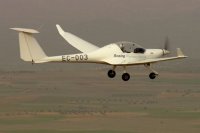
Supergiant aircraft manufacturer Boeing has flown a light aircraft – a Dimona motor glider – powered by hydrogen fuel cells.
The flights, which took place in Spain during February and March, are the results of many years of research and development – as we reported <a href=’http://www.flyer.co.uk/news/newsfeed.php?artnum=539′ target=’_blank’>last April</a> – which have been taking place in conjunction with UK company <a href=’http://www.intelligent-energy.com’ target=’_blank’>Intelligent Energy</a>.
According to Boeing, “the pilot of the experimental airplane climbed to an altitude of 1,000 meters (3,300 feet) above sea level using a combination of battery power and power generated by hydrogen fuel cells. Then, after reaching the cruise altitude and disconnecting the batteries, the pilot flew straight and level at a cruising speed of 100 kilometers per hour (62 miles per hour) for approximately 20 minutes on power solely generated by the fuel cells”.
The Dimona had been modified by Boeing Research and Technology, Europ to include a Proton Exchange Membrane (PEM) fuel cell/lithium-ion battery hybrid system to power an electric motor coupled to a conventional propeller. Thsee fuel cells convert hydrogen into heat and electricity, without by-products such as carbon dioxide.
Loughborough-based Intelligent Energy was responsible for creating the PEM system. “This is a new dawn for clean aviation, and the latest project to vindicate our view that hydrogen fuel cells can find applications in a wide variety of sectors. Boeing’s challenge to us was to provide a reliable and compact power system that could be integrated into such a light aircraft, and we delivered on our promise,” said Intelligent’s Henri Winand.