The UK Government has confirmed it will carry out a full review into rejoining the European Geostationary Navigation Overlay System (EGNOS).
It’s a move welcomed by regional airlines and aviation operators who say the loss of the satellite-based navigation aid has had a severe impact on reliability and safety.
The commitment came in response to a Parliamentary Question, with Aviation Minister Keir Mather stating that the Department for Transport will undertake “a comprehensive review” of the costs and practicalities of rejoining the programme in 2026, with a decision expected before the end of the year.
The announcement has been warmly received by Jonathan Hinkles, Chief Executive of Skybus, who has been one of the most vocal advocates for restoring UK access to EGNOS since Britain’s departure from the system in the wake of Brexit.
“Since the UK left EGNOS almost exactly five years ago, flight cancellations on lifeline air routes to and from our island communities due to adverse weather have trebled,” Hinkles said.

EGNOS acts as a satellite-based augmentation system (SBAS), improving the accuracy and integrity of GPS signals. For aviation, this means aircraft can fly Localiser Performance with Vertical guidance (LPV) approaches — precision-like approaches without the need for expensive ground-based equipment such as ILS.
That’s especially critical for smaller regional airports where installing and maintaining Instrument Landing Systems is often commercially unviable.
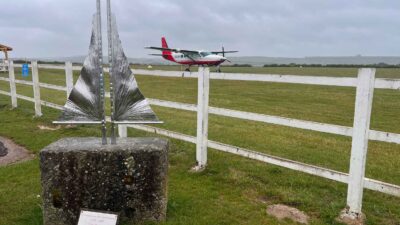
Before leaving the programme, UK regional airports including those in the Scottish Highlands and Islands, as well as Cornwall and the Isles of Scilly, benefited from these satellite-guided procedures.
For operators like Skybus, which serves the Isles of Scilly, EGNOS is more than just a convenience. In marginal weather, LPV approaches can mean the difference between operating safely and cancelling flights.
The impact is also wider than passenger transport. Air ambulance services, search and rescue operators, and maritime navigation all rely on the enhanced accuracy EGNOS provides.
One of the most frequently cited examples is Barra Airport, famous for its tidal beach runway, where poor weather and limited approach options can quickly ground operations.
The irony, as Hinkles points out, is that little has changed technically. UK aircraft remain equipped, pilots remain trained and the EGNOS signal still covers UK airspace.
The obstacle is legal rather than operational. Following Brexit, the UK lost access to the Safety of Life service because the legal indemnity framework underpinning the programme was withdrawn.
Rejoining would require political agreement with the European Union and renewed financial contribution to the programme.
For general aviation, too, a return to EGNOS would be significant. It would reopen opportunities for more advanced RNAV (GNSS) procedures across smaller UK airfields, improving accessibility and resilience across the wider network.
“It [a return to EGNOS] will make a tangible difference to our island communities and more besides, ” added Jonathan Hinkles. “And where, for the last three days, we’ve sat in fog and mizzle (a Cornish term for mist and drizzle combined), it can’t come a moment too soon for our customers.”
EGNOS