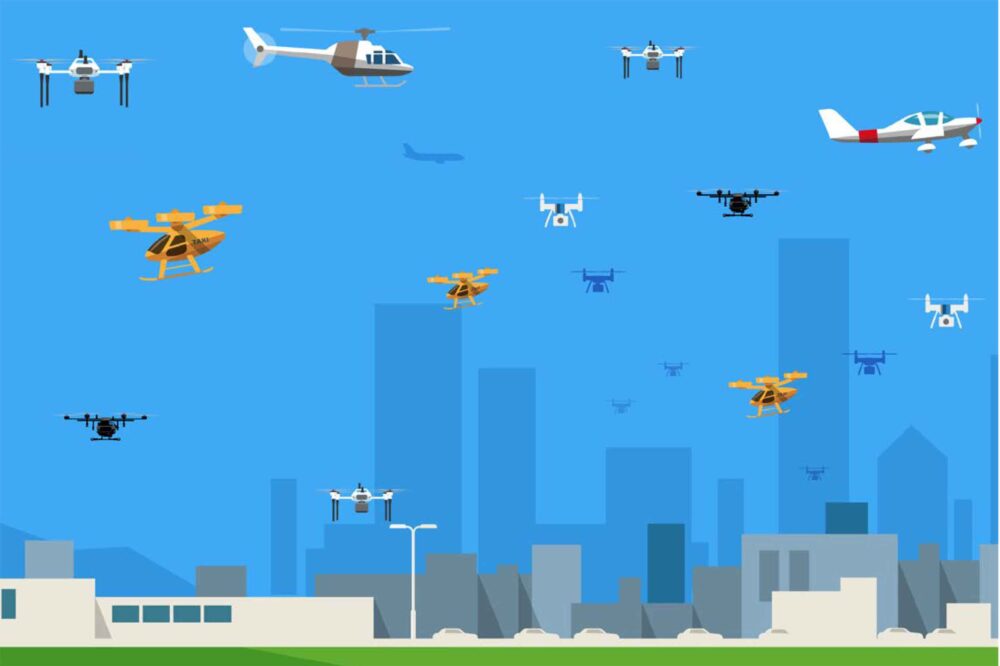
The Civil Aviation Authority (CAA) is consulting on the future of Unmanned Aircraft Systems Traffic Management (UTM), and while the documents stop well short of proposing mandatory electronic conspicuity for General Aviation, the supporting material offers a revealing glimpse of what the future might look like.
Officially, this is a consultation about how Beyond Visual Line of Sight (BVLOS) drones might safely share airspace with everyone else. Unofficially, it reads rather like the early chapters of a story many pilots suspect they already know the ending to.
The challenge facing the CAA is obvious enough. The Government wants routine drone operations at scale. The Civil Aviation Authority wants those operations integrated into normal airspace rather than hidden away inside endless Temporary Danger Areas and segregated corridors. Existing airspace users, meanwhile, would generally like to continue flying where they always have.
Something has to give.
The documents suggest the solution is a future airspace environment built around aircraft being electronically visible to each other and to the systems managing them.
The strongest clue comes in the proposed UTM standards, where the Civil Aviation Authority states that both unmanned and manned traffic must be capable of providing position and identity data. It goes on to identify CAP1391 ADS-B devices as the current requirement and notes that other electronic conspicuity technologies fall outside the safety requirements of UTM service provision.
That is not a mandate for ADS-B. Yet.
But it is difficult to avoid the conclusion that the Civil Aviation Authority has already decided which horse it is backing.
The UTM Concept of Operations goes further. Several future operating scenarios describe drones carrying ADS-B IN and ADS-B OUT, while manned aircraft are expected to carry ADS-B OUT. The repeated references to an “EC-based cooperative surveillance environment” leave little doubt about the direction of travel.
Perhaps the most telling concept is something called a Recognised Air Traffic Environment (RATE). In simple terms, this is an airspace environment where all participating aircraft are electronically conspicuous and therefore visible to the system. The consultation repeatedly identifies this type of environment as a key mitigation against mid-air collision risk.
That matters because it represents a subtle but important shift in thinking. Traditional Class G airspace assumes that not everybody is known to the system. The future envisioned here appears to assume that everyone is.
The documents also contain repeated references to strategic deconfliction, flight authorisation, airspace allocation, access requirements and usage requirements. None of those phrases will surprise drone operators. Some may make GA pilots slightly less comfortable.
To be clear, there is no proposal here to exclude aircraft without electronic conspicuity. There is no mandate. There is no requirement to fit ADS-B by a particular date. There is no consultation on restricting access to Class G airspace.
What there is, however, is an architecture that increasingly appears to depend upon electronic visibility.
One sentence buried within a future operating scenario is particularly revealing. Discussing a future operational scenario, the Civil Aviation Authority notes that “if EC is mandated, the establishment of a TMZ will not be required.”
That is not a proposal. It is not even a recommendation.
But it is an interesting thing to write if nobody is thinking about it.
For now, pilots should resist the temptation to overreact. The consultation does not propose mandatory electronic conspicuity and it does not seek new equipage requirements for General Aviation.
What it does reveal is the destination. The route, the timetable and the political appetite remain uncertain. But if routine drone operations are to become a normal part of UK airspace, these documents suggest the Civil Aviation Authority sees cooperative electronic surveillance as the answer.
The question for General Aviation is whether that remains a choice indefinitely, or whether one day it quietly becomes the price of admission.
The consultation